You are here:Home » News » How Raw Material Formulation Affects Stretch Film Cling, Strength and Production Cost
How Raw Material Formulation Affects Stretch Film Cling, Strength and Production Cost
Views: 0 Author: Site Editor Publish Time: 2026-09-08 Origin: Site
For packaging engineers and procurement managers, stretch film acts as more than a simple commodity. It functions as a critical variable in load containment. It directly impacts your overall operational overhead. Minor adjustments in stretch film chemistry dictate how the plastic performs under high tension. These subtle tweaks determine how securely it binds a moving pallet. They also establish what your final cost per load will ultimately be. Understanding the delicate trade-offs between base polymers, tackifiers, and specialized additives remains essential. You must master these variables to prevent over-speccing, which wastes valuable procurement budget. Conversely, you avoid under-speccing, which risks catastrophic load failure during transit. This guide breaks down the core elements of modern film chemistry. We will explore how different resins balance strength and flexibility. You will learn practical frameworks to evaluate performance metrics. This knowledge empowers you to match the right formulation to your specific machinery.
Key Takeaways
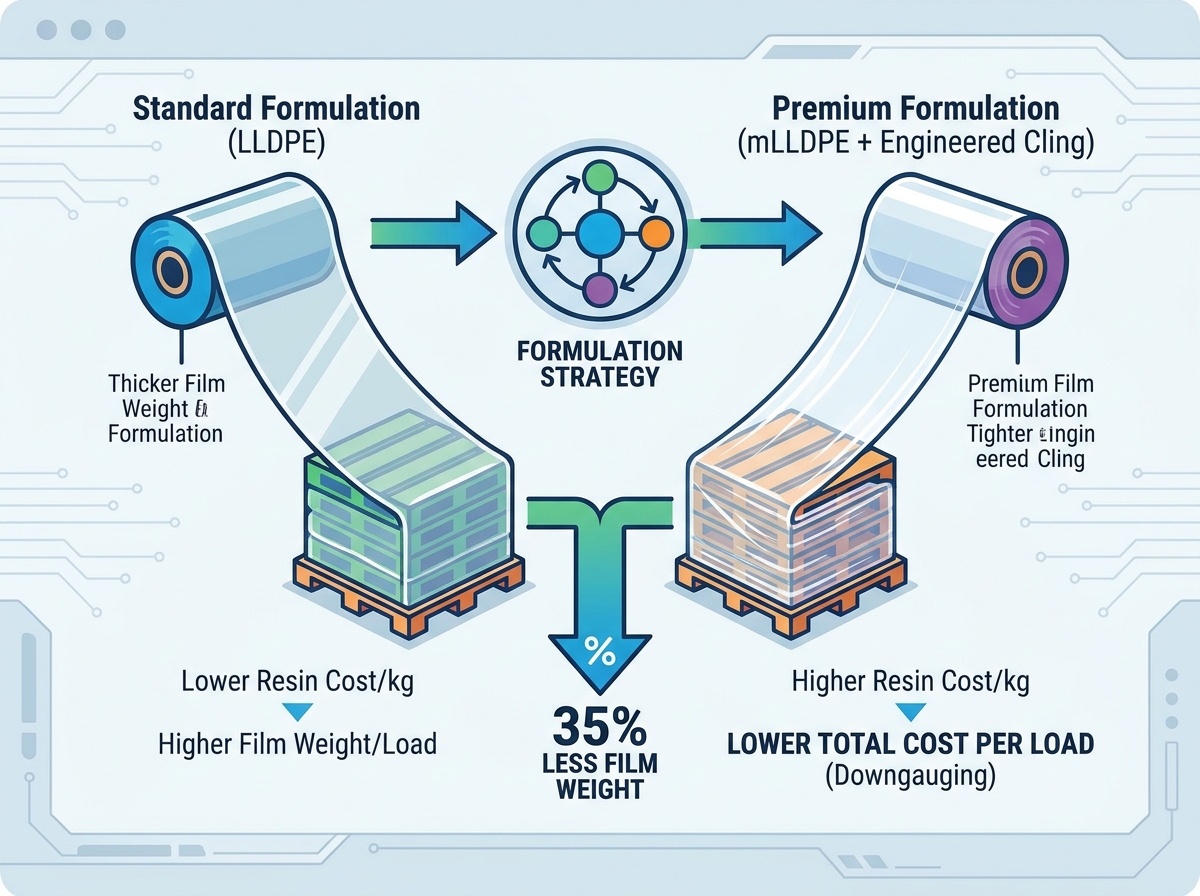
Formulating with Metallocene (mLLDPE) increases upfront resin costs but enables aggressive downgauging, lowering the true cost per load.
Cling strength is engineered through specific tackifiers (like PIB) or co-extruded layers, which must be matched to facility temperatures and application methods.
Balancing tensile strength with puncture resistance requires multi-layer co-extrusion strategies to optimize the base LLDPE resin.
Total Cost of Ownership (TCO) should be evaluated based on load containment force and wrap cycle efficiency, not just per-roll pricing.
The Business Impact of Stretch Film Raw Material Formulation
Packaging operations face a constant battle on the warehouse floor. Navigating the tension between material yield and load security requires precise decision-making. You want to stretch the film further to maximize your roll yield. However, you must maintain sufficient holding force to secure heavy pallets. This represents the core trade-off in industrial pallet wrapping. When you push a film beyond its chemical limits, it snaps. If you apply it too loosely, products shift and break during transit.
Standard material specifications often fail in real-world applications. Off-the-shelf formulations rarely account for specific transit rigors. A generic film might perform well on a static warehouse rack. Yet, it can loosen significantly during high-vibration truck transport. These failures lead to hidden costs in product damage. They also cause operators to apply excess wrapping. Workers compensate for weak materials by adding unnecessary extra layers. This inflates plastic consumption and slows down the packaging line.
You need clear success criteria for film evaluation. A successful formulation must yield a high pre-stretch percentage without losing structural integrity. It needs to provide consistent cling without leaving messy adhesive residue. Furthermore, it should offer stable pricing relative to global resin market fluctuations. When you optimize the stretch film raw material formulation, you directly improve your operational margins. Your facility uses less plastic daily. Loads arrive intact at their destinations. Production lines run continuously without frustrating web breaks. We must shift our focus from simple unit costs to actual performance outcomes.
Consider the best practices for initial evaluations. Always define your target containment force before testing new films. Different loads require different holding pressures. A pallet of heavy beverage cans needs aggressive tension. A pallet of empty plastic bottles requires gentle, elastic containment. Match your chemistry to your specific load profiles.
Base Polymers: Balancing Tensile Strength and Puncture Resistance
Polymers form the structural backbone of your packaging strategy. Manufacturers blend specific resin categories to build mechanical integrity. You must evaluate these core resins carefully to guarantee load security.
LLDPE (Linear Low-Density Polyethylene) remains the industry standard baseline. It provides a reliable balance of elongation and tear resistance. Standard LLDPE handles basic load profiles effectively. It is highly cost-efficient and widely available globally. However, standard LLDPE has stretching limits. It often struggles with sharp pallet corners or irregular load shapes.
Modern supply chains demand advanced solutions. This is where mLLDPE (Metallocene LLDPE) upgrades become vital. Metallocene catalysis fundamentally alters the molecular structure of the polymer chain. This advanced alteration exponentially increases puncture resistance. It also dramatically boosts tensile strength under extreme tension. As an outcome, facilities can safely downgauge their wrap. You use noticeably thinner films without sacrificing any load containment force. The upfront resin costs rise initially. However, your overall plastic consumption drops significantly.
Manufacturers rarely rely on a single polymer grade today. Instead, they utilize complex blends and multi-layer co-extrusion technology. Cast and blown extrusion methods distribute different polymer grades across multiple microscopic layers. Cast films cool quickly on chilled rollers, offering high clarity. Blown films cool slowly in ambient air, providing superior multidirectional toughness. Modern cast films often feature 3, 5, or even 7+ distinct layers. This isolates stiff strength properties in the core layer. The softer outer layers manage cling and surface slip. This multi-layer approach manages manufacturing costs while maximizing mechanical performance.
Table Title: Base Polymer Grade Comparison
Polymer Type
Primary Characteristic
Best Use Case
Cost Profile
Standard LLDPE
Balanced elongation and tear resistance.
Uniform loads, low-speed wrappers.
Low baseline cost.
Metallocene LLDPE
High puncture resistance and strength.
Irregular loads, sharp corners, high-speed lines.
Premium upfront cost.
Multi-Layer Blends
Targeted layer functionality (strength + cling).
Downgauging programs, automated transit lines.
Moderate to High.
Engineering Cling: Tackifiers and Surface Layer Chemistry
Proper adhesion prevents pallets from unraveling during chaotic shipping routes. You need the film layers to stick together firmly. However, they must never stick to adjacent pallets in the truck. Controlling this surface chemistry is a complex engineering challenge.
Many legacy manufacturers still use PIB (Polyisobutylene) additives. The mechanism operates simply but requires patience. PIB migrates slowly to the surface of the film post-production. It creates mechanical tack over time. The implementation reality presents several frustrating challenges. PIB requires a strict curing period for proper migration. Usually, this takes 24 to 48 hours. It can be highly sensitive to cold storage environments. Cold temperatures cause the film to lose tackiness quickly. Dust easily sticks to PIB, ruining its adhesive properties.
Inherently tacky elastomers offer a modern, reliable alternative. Products like Vistamaxx or advanced metallocene plastomers change the adhesion game. Suppliers integrate them directly into the outer skin layers during the co-extrusion process. The advantages are immediately apparent on the warehouse floor. You get instant cling right off the roll. Automated wrappers experience noticeably quieter unwind. These elastomers provide stable performance across much wider temperature variations. They completely eliminate the unpredictable curing time associated with older PIB methods.
You also must consider one-sided versus two-sided cling dynamics. Formulating the "slip" layer prevents pallets from sticking together during transit. This represents a critical compliance metric for modern logistics. High-density warehousing requires smooth, frictionless pallet loading. If two sticky pallets touch, they can tear the film instantly. A precision-engineered stretch film raw material formulation addresses this issue flawlessly. It ensures the outside remains slick while the inside clings tightly.
Common Mistakes in Cling Engineering
Relying on cheap PIB formulations in commercial blast freezer environments.
Ignoring the severe noise level of unwinding film on fast automated wrappers.
Failing to specify a high-quality slip layer for tight truckload shipments.
Storing PIB-based rolls in hot warehouses, causing excessive tackifier bleeding.
Formulating for Cost Efficiency and Manufacturing ROI
True scalability relies on transparent assumptions about underlying cost drivers. You must weigh resin market volatility heavily against specialized additive costs. Premium additives raise the manufacturing baseline cost noticeably. High-grade metallocenes and clear tackifiers are expensive bulk ingredients. However, they reduce the total volume of petroleum-based resin required per roll. You achieve significantly more stretch with much less material.
Consider the practical downgauging math. A 20% increase in formulation cost per kilogram might seem steep initially. Yet, this premium formulation can yield a 35% reduction in total film weight used per pallet. Your per-kilogram cost goes up on the invoice. Your per-pallet wrapping cost goes down on the floor. You wrap more pallets per roll. The net result improves your manufacturing ROI significantly. You also reduce your company's overall plastic waste footprint.
Scrap and extrusion efficiency directly impact the final purchase price. Poor formulation chemistry leads to microscopic gel formation during manufacturing. These hard gels create weak spots in the finished plastic. They cause sudden web breaks on the extrusion line. They create inconsistent roll profiles. Extrusion vendors will ultimately pass these manufacturing inefficiencies onto the buyer. High-quality resins process much smoother. They reduce machine downtime for the supplier. They yield consistent, defect-free rolls for the end user. Investing in a superior formulation saves money across the entire supply chain.
Watch out for overly cheap commodity films. Suppliers often blend recycled post-industrial scrap into the core layers to cut costs. While eco-friendly, poor blending drastically reduces the film's maximum stretch capacity. If you run high-speed wrappers, these cheap rolls will snap repeatedly. The downtime costs far exceed the initial savings.
Evaluation Framework: Shortlisting Specs for Your Facility
You cannot buy packaging plastics blindly. You need a highly structured approach to evaluate different chemical formulations. Follow these implementation considerations carefully to mitigate your operational risks.
First, audit your current machine capabilities thoroughly. Do not invest in high-performance, high-stretch formulations prematurely. If your existing stretch wrappers cannot exceed 150% pre-stretch, premium mLLDPE is wasted. Older machines lack the dual-motor carriages needed to stretch advanced plastics. Match the film’s engineered stretch capacity directly to your equipment’s physical gears.
Next, conduct the rigorous "Cut and Weigh" test. You must verify supplier claims independently using hard data.
Wrap a standard test pallet using your current baseline film.
Measure the containment force using a force-to-load scale.
Cut the film off the pallet carefully and weigh it on a gram scale.
Wrap the same pallet using the new formulation, matching the previous containment force.
Cut and weigh the new film accurately.
Compare the distinct weights to validate the actual material savings.
Perform strict environmental compatibility checks next. Laboratory tests do not replicate real-world warehouse conditions. Test cling and tear resistance in your actual operational environment. Blast freezers alter polymer flexibility dramatically. High-humidity loading docks affect surface adhesion and tack. Test the film precisely where it will perform daily.
For your next steps, request a customized material audit from prospective suppliers. Run a two-week pilot test before committing to any long-term procurement contract. Ask your operators for unvarnished feedback on the film's handling. Real-world validation prevents costly procurement mistakes and ensures smooth daily operations.
Conclusion
The optimal stretch film raw material formulation is rarely the cheapest option per pound. It is the specific chemistry that perfectly aligns LLDPE strength and engineered cling. It maximizes downgauging potential directly for your specific machinery and load profiles. You secure transit loads better while consuming far less plastic annually. This balanced approach protects your products and improves operational efficiency simultaneously.
Take concrete action today. Encourage your procurement buyers to request technical data sheets (TDS) from every supplier. Use these detailed documents to verify metallocene content and specific tackifier types. Schedule an on-site wrap efficiency audit with a packaging engineer. Stop guessing at your containment forces and start measuring them accurately. A scientific, data-driven approach to your packaging materials guarantees better transit outcomes.
FAQ
Q: How does temperature affect stretch film formulation performance?
A: Cold environments stiffen standard LLDPE drastically. Freezing temperatures neutralize PIB-based cling mechanisms. The tackifier cannot migrate or stick. Specialized cold-room formulations require specialized elastomeric tackifiers. These elastomers remain flexible and sticky even in sub-zero blast freezers. Heat can also cause PIB to bleed excessively, making rolls messy.
Q: Can a thinner film actually provide better strength?
A: Yes. If the formulation relies on higher percentages of mLLDPE, it becomes exponentially tougher. Multi-layer nano-technology also reinforces the structure. Thinner films engineered with these advanced resins can easily outperform thicker, low-grade commodity films. Downgauging works when the molecular structure supports high tension without tearing.
Q: Why does some stretch film leave a sticky residue?
A: Excessive or poorly integrated migrating tackifiers cause this issue. Low-quality PIB can pool heavily on the film's surface over time. This pooling causes sticky residue buildup on machine rollers. It also transfers to adjacent pallets during shipment. Switching to inherently tacky elastomers solves this messy problem permanently.
 English
 العربية
 Français
 Русский
 Español
 Português
 Deutsch
 italiano
 日本語
日本語 한국어
한국어 Nederlands
 Tiếng Việt
 ไทย
ไทย Polski
 Türkçe
 ភាសាខ្មែរ
 Bahasa Melayu
 ဗမာစာ
ဗမာစာ தமிழ்
தமிழ் Filipino
 Bahasa Indonesia
 Română
 Čeština
 Монгол
 қазақ
қазақ Српски
 हिन्दी
 فارسی
فارسی Kiswahili
 Slovenčina
 українська
 Հայերեն
 Latine
 Dansk
Dansk اردو
اردو Shqip
Shqip বাংলা
বাংলা Hrvatski
 Afrikaans
 Gaeilge
 Oʻzbekcha
 latviešu
 Azərbaycan dili
 Беларуская мова
 Bosanski
 ગુજરાતી
 Basa Jawa
 Kinyarwanda
 Кыргызча
 Македонски
 Malti
Malti