You are here:Home » News » Factory Requirements for Installing a Cast Stretch Film Production Line
Factory Requirements for Installing a Cast Stretch Film Production Line
Views: 0 Author: Site Editor Publish Time: 2026-09-08 Origin: Site
Purchasing a cast stretch film extrusion line is a multi-million-dollar capital expenditure. Realizing maximum return on investment depends heavily on facility readiness. Underestimating site preparation leads directly to delayed commissioning. It also causes degraded film quality and premature equipment wear. You cannot simply drop heavy industrial extrusion equipment onto a standard warehouse floor without severe consequences.
This guide outlines the precise facility parameters you need. We cover the infrastructure upgrades and environmental controls required. You will learn how to successfully integrate a high-speed cast stretch film machine into your current operations. Proper planning bridges the gap between advanced machinery and your existing plant capabilities.
Before finalizing procurement, evaluate your facility against these core mechanical, electrical, and structural baselines. Use this framework to audit your factory layout. Thorough preparation prevents costly bottlenecks and ensures smooth equipment commissioning.
Key Takeaways
Structural Load is Non-Negotiable: Cast lines require heavily reinforced, perfectly leveled concrete foundations to support extreme machine weight and prevent vibration-induced winding defects.
Cooling Dictates Output: Chilled water infrastructure must handle rapid temperature drops at the casting roll; inadequate cooling directly bottlenecks production speed.
Power Stability Requires Auditing: High-capacity transformers and stable voltage are mandatory to support multiple heating zones and high-torque extruder motors.
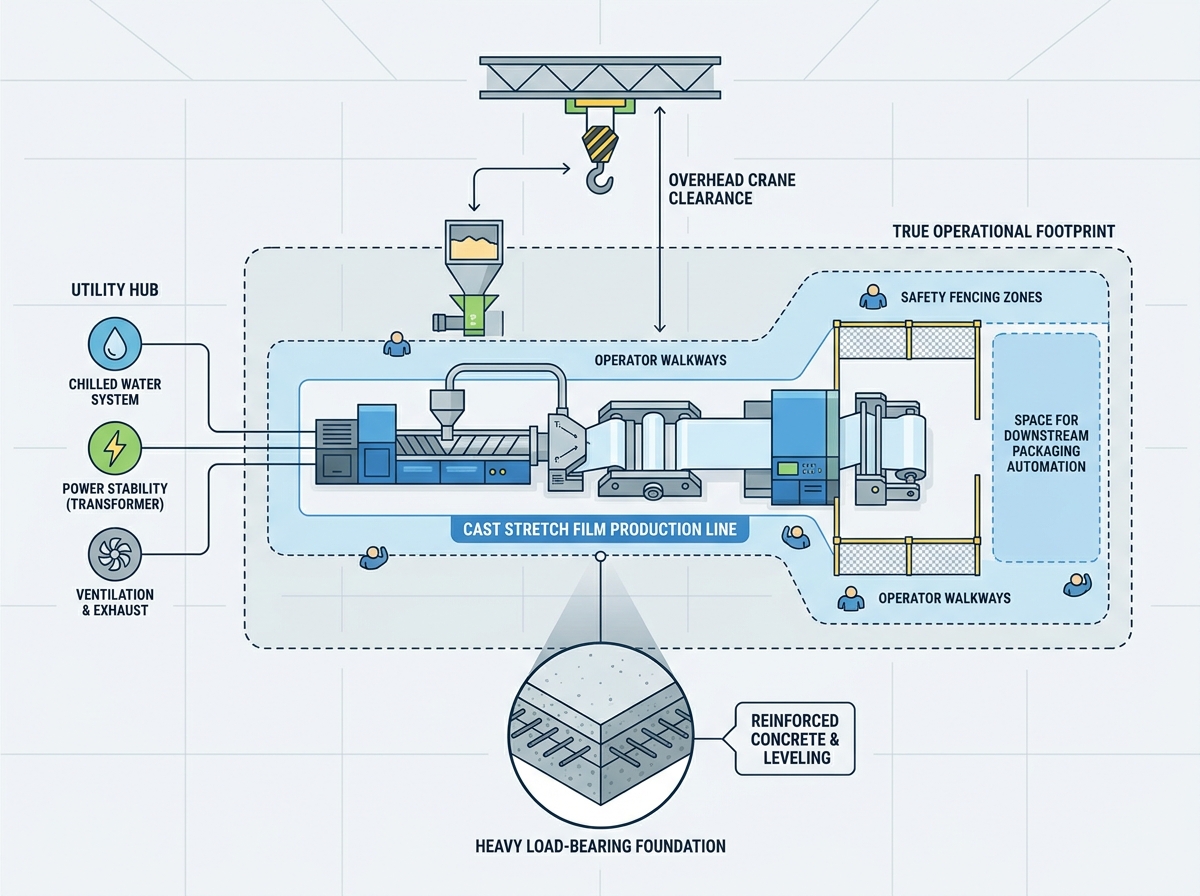
Spatial Logistics Matter: Beyond the machine's footprint, factories must account for overhead crane clearance (for die maintenance) and raw material silo placement.
Space, Layout, and Structural Load-Bearing Needs
Calculating the True Footprint
We must contrast the machine’s static dimensions with operational space requirements. Static dimensions never tell the full story. You must allocate ample room for operator walkways around the entire perimeter. Safety fencing and interlock gates require additional square footage. Furthermore, downstream packaging automation, such as robotic roll handlers and palletizers, demands massive spatial integration.
Address the specific horizontal footprint of cast lines early in the planning phase. Cast film machines stretch out horizontally across the factory floor. They differ greatly from the extreme vertical demands of blown film towers. Plan your factory layout to accommodate long downstream winding systems without restricting general plant traffic.
Foundation and Floor Requirements
Specify necessary concrete thickness and load-bearing capacity meticulously. Standard commercial flooring rarely handles industrial extrusion weights. You must support extruders, massive steel chill rolls, and heavy winding turrets. Floor load-bearing capacities often need to exceed several tons per square meter. We highly recommend consulting a geotechnical engineer to take core samples of your existing floor.
We must highlight the critical importance of floor leveling. Absolute floor flatness ensures uniform film gauge and wrinkle-free winding. Uneven floors cause micro-vibrations to travel through the machine frame. These vibrations disrupt the sensitive melt curtain as it hits the casting roll, creating permanent visual defects in your finished stretch film.
Overhead Clearance and Cranes
Outline strict height requirements for raw material handling. Tall material hoppers and multi-component gravimetric dosing units sit high above the extruders. Measure your ceiling clearance carefully. You must accommodate these feeding systems while leaving room for pneumatic conveying tubes.
Explain the absolute necessity of an overhead gantry crane or hoist system. Routine maintenance requires operators to safely remove heavy T-dies and massive casting rolls. A rated overhead crane makes these tasks secure and efficient. Attempting to maneuver multi-ton dies with forklifts creates severe safety hazards and often damages precision equipment.
Electrical Infrastructure and Power Sizing
Total Connected Load vs. Operating Load
Guide your engineering team to evaluate existing facility power limits carefully. You must balance current capacity against the precise stretch film machine installation requirements before equipment arrives. Extruder heating zones, large drive motors, and dual-turret winders consume massive amounts of electricity during startup. Operating load drops once the machine reaches steady-state, but your electrical mains must handle the peak connected load.
Discuss the critical need for dedicated transformers. We advise isolating the extrusion line from other heavy factory equipment. Sudden voltage drops from neighboring machinery can disrupt your extrusion consistency. Dedicated power infrastructure protects the sensitive PLC controls on your cast line.
Voltage Stability and Phase Requirements
Explain the severe risks associated with voltage fluctuations. Unstable voltage creates inconsistent melt temperatures inside the extruder barrel. It also triggers frequent drive faults in the electrical cabinets. If your local power grid proves unreliable, we strongly recommend installing heavy-duty industrial voltage stabilizers.
Three-phase power symmetry is equally important. Phase imbalances cause motors to overheat and fail prematurely. Have your electrical contractor verify phase balance across the entire installation site.
Cable Routing and Trenching
Implement strict best practices for separating cables. You must separate high-voltage power cables from sensitive control and communication cables. Use dedicated floor trenches or suspended overhead cable trays to organize wiring.
This physical separation prevents electromagnetic interference (EMI). High-voltage lines generate magnetic fields. If control wires sit too close, EMI corrupts data signals between sensors and the central PLC. Signal corruption leads to random machine shutdowns and erratic winding tension.
Industrial Cooling and Water Systems
The Role of Chilled Water in Cast Film
Explain why the chill roll acts as the ultimate production bottleneck in cast film manufacturing. The casting roll rapidly quenches the molten polymer immediately after it exits the T-die. This rapid cooling dictates film clarity, elongation properties, and mechanical strength. It directly determines your maximum line speed.
If cooling capacity falls short, operators must slow down production to prevent film sticking. Robust chilled water infrastructure ensures you run the machine at its advertised nameplate capacity.
Chiller Capacity Sizing
Evaluate your existing centralized cooling framework carefully. Central plant cooling rarely handles the specific demands of a new, high-speed extrusion line. You typically require a dedicated, closed-loop industrial chiller positioned near the machine.
Check vital sizing variables before finalizing the chiller purchase. Measure the required water flow rate in liters per minute. Assess maximum operating pressure limits for the rotary joints. Calculate the required temperature differentials across the chill roll to ensure even cooling across the entire web width.
Address the major risks of poor water quality. Scaling, internal corrosion, and particle blockages destroy chill roll efficiency. Internal roll channels must remain pristine. Once scale builds up inside the roll, heat transfer drops exponentially. You will experience uneven film cooling, leading to gauge bands and loose roll edges.
Recommend professional water treatment systems. Demineralization setups maintain high heat transfer efficiency. Consider adding bio-cides to closed-loop systems to prevent algae growth inside cooling towers and piping.
Environmental Control, Ventilation, and Safety
Temperature and Humidity Management
Discuss how ambient factory temperatures affect production stability. High summer heat alters resin melting behavior inside the extruder feed throat. Hot environments also decrease overall chiller efficiency. Furthermore, high ambient humidity severely shortens the lifespan of sensitive electronic components inside the main control cabinet.
Keep your facility climate-controlled where possible. If full air conditioning proves impossible, install industrial exhaust fans to cycle hot air out of the building canopy.
Fume Extraction and VOC Management
Address the reality of industrial plastic fumes. Melting linear low-density polyethylene (LLDPE) at high temperatures generates noticeable smoke. Edge-trim recycling systems also release volatile organic compounds (VOCs) when re-pelletizing scrap film.
Outline strict requirements for localized exhaust ventilation. Install custom extraction hoods directly above the T-die. Route this exhaust safely outside the building through specialized filtration units. This maintains occupational safety for machine operators. It also ensures full regulatory compliance with local environmental laws.
Dust Control
Explain why a relatively clean environment remains necessary. Dust settling on the chill roll creates immediate, repeating visual defects. Contamination on the film web severely compromises the final product's cling properties.
Implement practical dust control measures. Keep exterior roll-up doors closed during production. Apply epoxy coatings to the concrete floor to prevent concrete dusting. Control forklift traffic near the extrusion die to minimize airborne debris.
Logistics and Raw Material Handling Readiness
Silo and Resin Feeding Systems
Evaluate available space for bulk exterior or interior silos. Buying resin in bulk significantly improves operational efficiency and reduces manual labor. Plan your pneumatic conveying piping routes carefully. You need robust stainless-steel piping to move resin pellets directly to the extruders.
Avoid sharp 90-degree pipe bends during installation. Sharp bends shatter resin pellets into fine dust during transport. This dust clogs gravimetric blenders and carbonizes inside the extruder barrel.
Material Flow and Forklift Access
Calculate required turning radiuses for factory forklifts. Forklifts constantly move heavy jumbo rolls of finished stretch film. Operators transport these rolls away from the winders to the designated curing or shipping areas. Tight corners lead to damaged products, scratched safety fences, and severe safety incidents.
Plan specific staging areas for daily raw materials. Designate clear zones for LLDPE resin pallets. Create safe, temperature-controlled storage for tackifiers or PIB liquid drums if you use them. Organize dry storage racks for 2-inch or 3-inch paper cores immediately adjacent to the winding turrets.
Pre-Installation Site Audit: Next Steps for Procurement
Vendor Alignment
Align your expectations with the machine vendor immediately. Request a detailed foundation plan well before signing the final contract. Ask for a comprehensive utility consumption chart detailing peak electrical and water demands. This manufacturer documentation forms the structural foundation of your site preparation strategy.
Third-Party Engineering Review
Hire structural engineers early in the procurement process. They must verify floor strength and analyze sub-surface soil conditions. Hire licensed electrical contractors to audit your existing transformer capacity and inspect plant busbars. Never guess your facility limits when dealing with heavy industrial extrusion lines.
Shortlisting Logic
Factor installation readiness deeply into your equipment choice. Does a slightly more expensive machine offer a more compact footprint? Does it provide vastly better energy efficiency through direct-drive motors? Superior machine design often saves you tens of thousands in required facility upgrade costs. Let site readiness guide your final vendor selection.
Conclusion
Successful deployment of a cast stretch film line requires a symbiotic relationship. Advanced machinery needs robust factory infrastructure to function profitably. A world-class extruder cannot overcome a weak foundation or undersized electrical transformers.
We strongly warn stakeholders against the hidden costs of retrofitting utilities mid-installation. Discovering power shortages or inadequate cooling capacity during commissioning destroys project timelines and delays revenue generation.
Take action before signing purchase agreements. Encourage your engineering decision-makers to download a comprehensive site-readiness checklist. Always consult directly with your equipment manufacturer for a custom facility audit prior to finalizing your purchase.
FAQ
Q: How thick does the concrete floor need to be for a cast stretch film machine?
A: Concrete thickness typically ranges from 200mm to 300mm, heavily reinforced with steel rebar. However, you must conduct a specific geotechnical evaluation based on the manufacturer's exact weight distribution map. Standard warehouse floors rarely possess the necessary load-bearing capacity to safely support heavy extruders and massive steel chill rolls over time.
Q: Can we run the extrusion line on our existing factory cooling tower?
A: No, standard cooling towers are insufficient. Factory cooling towers typically provide water at ambient temperatures. Cast rolls require precision chilled water (often controlled precisely between 15°C and 20°C) delivered by a dedicated industrial chiller. This guarantees rapid quenching, high film clarity, and maximum production speeds.
Q: What are the standard ceiling height requirements for a cast film line?
A: Cast lines feature a much lower horizontal profile compared to towering blown film lines. Still, you typically need a minimum ceiling height of 6 to 8 meters. This vertical space accommodates overhead raw material dosing hoppers and provides clearance for the essential gantry crane needed for heavy die maintenance.
Q: How long does site preparation typically take before the machine arrives?
A: Site preparation generally takes two to three months. This practical timeline accounts for structural engineering assessments, trenching, pouring reinforced concrete, proper curing times (up to 28 days), and routing heavy electrical cables and chilled water piping before the equipment delivery date.
 English
 العربية
 Français
 Русский
 Español
 Português
 Deutsch
 italiano
 日本語
 한국어
 Nederlands
 Tiếng Việt
 ไทย
 Polski
 Türkçe
 ភាសាខ្មែរ
 Bahasa Melayu
 ဗမာစာ
 தமிழ்
 Filipino
 Bahasa Indonesia
 Română
 Čeština
 Монгол
 қазақ
 Српски
 हिन्दी
 فارسی
 Kiswahili
 Slovenčina
 українська
 Հայերեն
 Latine
 Dansk
 اردو
 Shqip
 বাংলা
 Hrvatski
 Afrikaans
 Gaeilge
 Oʻzbekcha
 latviešu
 Azərbaycan dili
 Беларуская мова
 Bosanski
 ગુજરાતી
 Basa Jawa
 Kinyarwanda
 Кыргызча
 Македонски
 Malti